

Executive Summary
Most organizations still decide first and learn second. They launch the campaign, announce the policy or open the facility, then find out how people feel about it. Decision support tools reverse that order. This month, KOSU asked Oklahoma pollsters and a computer science professor to evaluate Foundry DST, a decision support tool Saxum built for Oklahoma. The reporting shows what leaders gain when insight comes before action, how to read a forecast with a confidence score attached, and why Saxum is building more tools like it.
Key Takeaways
- There are more ways than ever to understand how people will respond.
Polls, focus groups, surveys and now AI modeling each answer that question in a different way, and each has its place.
What to do next: List the tools you rely on today and the questions they leave unanswered. - AI has made audience modeling accurate and fast in a way that wasn’t possible a short time ago.
A read on how people are likely to respond, which once took weeks of fieldwork, can now come back the same day.
What to do next: Revisit one decision you made without testing because research would have taken too long. - New tools earn trust through public, verifiable tests.
Elections give any model a certified, county-level result to be measured against, which makes them a fair public test.
What to do next: Ask any new research or modeling partner to show you a public track record.
A decision support tool helps leaders make a consequential call with better evidence before they act. The decision stays with the leader. The tool shows how people are likely to respond, how confident that read is, and where the risk sits, so the person accountable for the decision can choose with more of the picture in view.
That definition matters more than ever, because the decisions landing on leaders are multiplying and getting riskier.
What Did Independent Experts Find When They Evaluated Foundry?
On October 12, KOSU reporter Lionel Ramos published “An Oklahoma consulting firm is selling an AI tool that can predict elections, but can it be trusted?” The story was also carried by Public Radio Tulsa and KGOU.
Ramos put Foundry DST through its paces. He looked at how it works, compared its election readings with certified results, and asked two longtime Oklahoma pollsters and a Stony Brook University computer scientist to weigh in. When people who have measured Oklahoma opinion for decades take a close look at a new approach, it is a sign the field is paying attention.
In August’s Republican runoff for governor, the article reports Foundry’s call “was off by less than half a percent.” The article describes that level of accuracy as one that “borders on the uncanny.” It also notes that Foundry missed the first round of the June primary, and that Saxum adjusted the model afterward.
The experts were fair and direct about what any model can and can’t do. Pat McFerron, president of Cole Hargrave Snodgrass & Associates, said modeling “always seems to have its limitations because individuals are individuals.” Bill Shapard of Sooner Poll said AI “does not replace collecting data and making sure the data is a probability sample of the population of interest.
We agree. Foundry DST works as a standalone intelligence engagement or alongside traditional research, and a strategist interprets every result. What it adds is a county-by-county read on how Oklahoma is likely to respond, available in time to shape the decision.
Where Did Foundry DST Come From?
Foundry DST did not start as an election tool. Saxum built it to help Oklahoma decision-makers understand how their messages and decisions would resonate with Oklahomans, county by county, before going public. Its first job was testing messages before they went to market, for organizations across many sectors, including some of the most sensitive.
Until recently, there was no practical way to model that kind of response. A survey could take weeks or months and a significant budget, and by the time the results came back, the ground might have shifted.
Elections entered the picture during the run-up to June’s Republican primary for governor. State Question 832 was tested at the same time, and Foundry DST read it with exceptional accuracy. Elections have since become a valuable public test. They come with published polling, a certified outcome and a county-by-county breakdown, so anyone can check the work. That is why Saxum publishes Foundry DST’s election readings, and why reporters like Ramos can examine them.
How Should Leaders Read a Forecast?
The clearest example is in front of Oklahomans right now. Foundry runs a general election tracker, and its October 12 reading of the governor’s race shows a projected two-way vote share of 60.5% for Mike Mazzei (R) and 39.5% for Cyndi Munson (D).
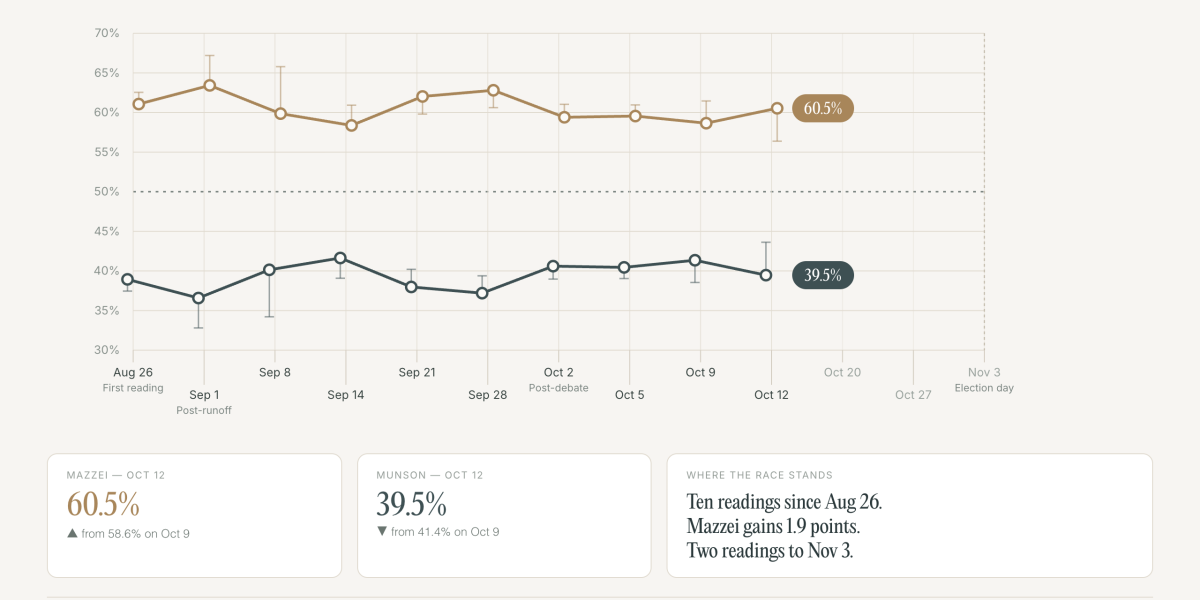
Three things help a leader read a chart like this.
The confidence score is about the margin. Each reading carries a confidence score, here 80% for Mazzei’s 60.5% and 81% for Munson’s 39.5%. That score tells you how confident the system is that the result will land at about that share. It is not a measure of the odds that one candidate wins.
The margin is where accuracy shows. For a decision-maker, the useful question is often less about who finishes first and more about by how much, and where. That is where Foundry has been tested in public. On State Question 832, Foundry projected 55.42% would vote no, and the certified result was 55.38% opposed. In the August runoff, its final reading came in within half a point of the certified result. Both are documented in our published reviews of the primary and the runoff.
Every reading is dated and has limits. The tracker is re-run as new evidence enters the race, so each point is a snapshot. The two-way share leaves out independent and write-in votes, and three independent candidates are on the ballot.
Foundry’s readings are dated, change with each run and are not an endorsement of any candidate.
Why Does Insight Before Action Matter for Bedrock Organizations?
Hart Brown, Saxum’s President, AI & Transformation, described the shift to KOSU this way:
“In most cases, we’ve designed campaigns, and then we put information out, and then we start learning what the reaction of people is. And so turning that around and using more and more data in the beginning is a bit of a shift.”
Hart Brown, President, AI & Transformation, Saxum
For a bedrock organization, the cost of learning after the fact is high. A facility announcement that lands badly in three counties, a policy position that organizes opposition before it is public, or a campaign that spends its budget before anyone checks the message all carry costs that compound. Seeing the response first lets a leader adjust while the decision is still open.
What Comes After Foundry?
Foundry is a decision support tool built for Oklahomans and the organizations that serve them. It is also one of several decision support tools Saxum is building.
The next one looks inward. Many organizations have a clear, ambitious goal and a fixed window to reach it, and they need focused strategic help to get there in the time they have. Bedrock Alignment was built for them. It is “A 30-day alignment diagnostic across industry, market, and organization, built to identify the vital strategies to reach your goal.”
Foundry shows how Oklahoma is likely to respond. Bedrock Alignment shows where your organization stands and which strategies will move it toward the goal. Both are backed by Saxum strategists, and a leader can start with either, depending on the decision in front of them.
If a decision about your organization’s direction is sitting on your desk, start with where you stand.
See how Bedrock Alignment works
Saxum is an outsourced Chief Strategy Office: senior strategists and purpose-built intelligence tools that help you see what’s changing, decide what to do, and move before it costs you.
