
The radar for what Oklahoma thinks, not just statewide, but street-by-street.
Foundry DSTSM Decision Intelligence that maps how Oklahoma will respond to your message before you send it. It’s county-level sentiment intelligence for Oklahoma.
THE REALITY
Oklahoma is not one audience.
It never was.
A message that works in Oklahoma County can actively alienate Cimarron County. A frame that moves Tulsa doesn’t move Woodward. Every communicator in this state knows it. Almost none have had a way to prove it, or fix it before launch.
Foundry DST maps how all 77 counties respond to your specific message, before you send it. County-level. Confidence-rated. Delivered by a Saxum strategist who knows what those results mean for your work.
50%
business decisions that fail to deliver the intended value by rushing to judgment without information or failure to explore alternatives.
49%
have developed stagnant decision styles that obscure decision results and reduce the ability for the organization to learn over time.
FEATURES & CAPABILITIES
Efficient real-time answers that can lead to real-time statements and real-time pivots.
The Problem
You can feel the difference.
You can feel the difference between Tulsa and the panhandle. You just can’t prove it. Can’t put it on a slide. Can’t defend it in a boardroom.
The Difference
One shot is not enough.
Traditional research gives you one expensive shot and tells you what went wrong after the fact. No refinement. No second pass.
The Capability
Know the ground before you enter it. Fast.
Foundry DST maps how all 77 counties respond to your specific message — green, yellow, red — with confidence-rated reasoning. In minutes, not months.
The kind of speed that used to mean shallow. The kind of depth that used to mean weeks. Foundry DST delivers both, because it was built from the ground up for this state, not adapted to it.
The Loop
Don't just diagnose. Fix it.
When counties resist your message, Foundry DST shows you what language works, what to avoid, and delivers optimized rewrites. Then your strategist refines and re-runs until it lands.
You’re not buying one analysis. You’re buying the answers.
Clarity on Stakeholder Response
Accelerated Influence
Systemic Resilience
County
The Input
Data no one can buy.
24+ dimensions. Thirty-three tribal counties. Thirty-nine federally recognized tribes. Built on layers of Oklahoma-specific intelligence accumulated over twenty years of actual Oklahoma relationships— not just census data, not scraped feeds. Real-time trend signals and news cycle integration in every run.
Multimodal
Whatever form your message takes.
Text. Video. Images. A 30-second spot. A social post. The actual creative you’re planning to run. Foundry DST analyzes any format, because real campaigns don’t arrive in one shape.
•
.jpg
•
.mp4
•
text
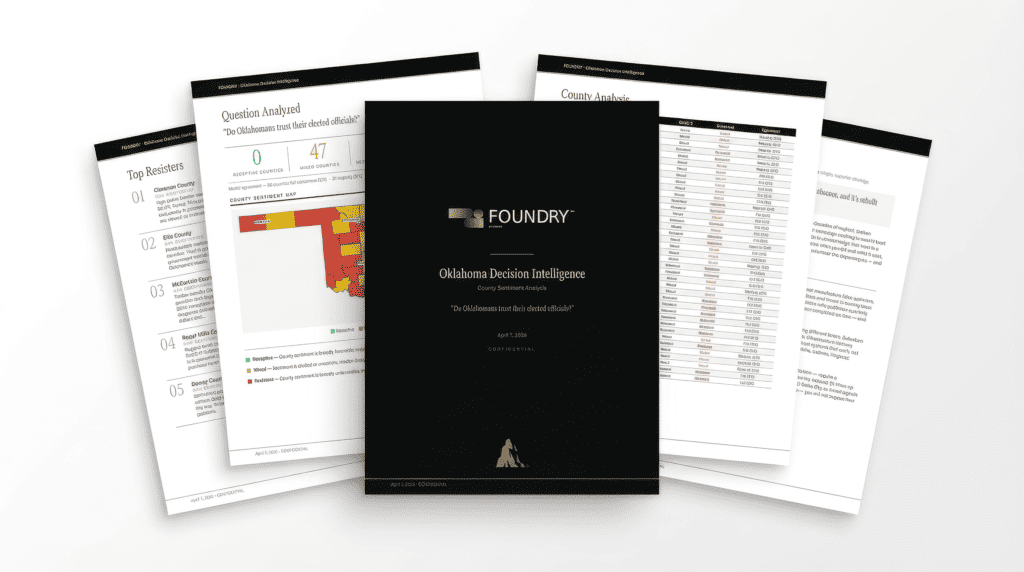
A Foundry DST Brief is a complete strategic intelligence report delivered by a Saxum strategist covering all 77 Oklahoma counties, built around your specific question or message.
Intake
01
Before anything runs, a Saxum strategist meets with you to frame the intelligence runs around your specific question, audience, and what’s at stake. Most intakes take 30 minutes. Briefs are ready within 1–2 business days.
County Sentiment Map
02
A visual breakdown of how Oklahoma responds to your question, county by county, categorized as Receptive, Mixed, or Resistant with confidence ratings from our multi-model ensemble.
Top Supporters & Top Resisters
03
The counties with the strongest sentiment in either direction, with the cultural, economic, and political context behind each position.
Messaging Recommendations
04
Specific frames that work, frames to avoid, and tailored guidance for swing counties, resistant communities, and tribal considerations.
Synthesized Messaging
05
A refined, single-voice recommendation that draws from the full analysis — what to say, how to say it, and where to start.
The most likely opposition angles and how to address them before they surface.
Confidence Scoring
06
Ensemble confidence score showing model agreement and reliability of the analysis.
News Cycle Opportunity
07
Current stories with leverage angles and suggested hooks relevant to your question.
Full County Analysis
08
A complete table showing model-by-model scores and consensus ratings for all 77 counties.
Walkthrough*
09
After the brief is delivered, your Saxum strategist walks you through the findings in a live session — interpreting what the intelligence means for your situation and helping you decide what to do next.
* optional
INSIDE FOUNDRY DST℠
Behind every Foundry DST Brief and every expert-trained Saxum strategist sits Oklahoma's most complete intelligence capability.
- 3 models working in parallel
- 77 Oklahoma Counties
- 40 active news sources
- Nearly 15,000 Data Points from the Oklahoma Factbook
HOW IT WORKS
Intelligence delivered, not software learned.
01
Bring your message.
Share the message, policy, or campaign concept you’re planning, text, video, creative, whatever form it takes. Your Saxum strategist shapes it into a precise question. The work starts from your challenge, not a template.
•
text
•
.mp4
•
.jpg
02
See the terrain.
Three independent models evaluate your message using Saxum’s proprietary county dataset— the Oklahoma FactBook.
For the first time, you see exactly where your message lands, and where it meets resistance. It’s a defensible assessment coded in green, yellow, red. All 77 counties. Confidence-scored reasoning behind every result.
03
Refine until it lands.
Your strategist identifies what’s causing resistance, adjusts the language, and re-runs. Three to four passes until county-level targets are met. By the time you walk out, the message has been tested against Oklahoma, not just reviewed.
•
_r3
•
_r2
•
_r1
04
Walk in knowing.
You receive a Foundry DST Brief: county-level intelligence, confidence-scored recommendations, and a presentation-ready map. The kind of evidence that settles a room. You didn’t guess. You knew.
All without the hassle and expense of list making, calls, text messaging, polls, surveys, bothering people, unnecessary disclosures of direction, signaling of intent.
THE INTELLIGENCE
Navigate the terrain of public opinion.
Diagnose
01
Identify baseline regional biases before committing resources. Understand the pre-existing conditions of a county’s political and social landscape regarding your specific issue, message or content.
Prescribe
02
Determine the exact phrasing, messengers, and channels required to penetrate specific regions. Move from broad assumptions to targeted localized strategies. Map economic sentiment and community receptivity. Know which counties are aligned with your message and which need a different conversation.
Optimize
03
Iterate messaging based on simulated feedback loops. Adjust tone and emphasis to mitigate backlash in resistant counties without diluting the core message in supportive ones.
Visualize
04
Present complex sentiment data to stakeholders through stark, uncompromising data visualizations. Remove emotion from the strategic decision-making process. See the full terrain of Oklahoma opinion rendered as actionable intelligence. Presentation-ready maps and confidence-rated county breakdowns.
LIMITLESS IDEAS
APPLICATIONS
Built for the people who carry the weight of getting Oklahoma right.
Whether you’re managing a statewide health campaign, navigating energy policy across competing constituencies, or defending a communications strategy in a boardroom, Foundry DST gives you the county-level intelligence to walk in knowing.
Government Affairs
- The window before a position is public is the only window that fully remains open.
- Opposition doesn’t appear from nowhere. The counties most likely to organize are knowable before they do.
- The professionals who move first in Oklahoma policy don’t have better instincts. They have better information.
Oklahoma politics doesn’t move statewide. It moves county by county, constituency by constituency, through communities that have different economic relationships to every issue that reaches the legislature or a regulatory agency.
The professionals who operate most effectively in this environment understand that the window before a position is public is the only window that fully remains open. Once a statement is made, a vote is committed, or a stance is on record, the room for adjustment narrows fast.
Foundry DST is built for that window. Before a bill is introduced, a county-level receptivity map reveals which districts carry concentrated opposition and which stakeholders need to be in a room before the filing, not after. Before a regulatory comment period opens, Foundry DST maps who will show up, from which counties, organized around which specific objections. Before a public appropriations argument is made, county-level intelligence about where the need is greatest and where support is already latent changes what gets said and who says it.
Coalition sequencing changes when you can see the terrain in advance. The constituencies you bring in first, the communities that need a different conversation before they’re in the same room as others, the counties where a specific frame will read as relevant versus political. That sequencing is the difference between an effort that builds momentum and one that stalls before it starts.
Opposition doesn’t appear from nowhere. The counties most likely to generate organized response to a given position carry signals that are visible before the position goes public. Foundry DST surfaces them at the moment when that intelligence can still shape what you do, not just how you respond to what follows.
Public Health
- The front end is where intelligence has the most leverage. By the time traditional research delivers, the decisions that needed it have already been made.
- A statewide campaign is one situation where county-level intelligence changes outcomes. It is not the only one.
- Where a program is placed is an allocation decision. Foundry is built for the moment before that decision is made.
A statewide health campaign is one situation where county-level intelligence changes outcomes. It is not the only one, and for most public health leaders, it may not even be the most consequential one.
Before a new clinic, behavioral health program, or treatment service is placed, the question of where it goes is an allocation decision. Which counties have the highest unmet need alongside the lowest barriers to engagement? Where will community trust support uptake and where will it require a different approach entirely? Those answers exist before the program is designed. Most public health teams don’t have access to them at the point when the design is being made.
Vaccine and treatment hesitancy isn’t uniform across Oklahoma’s 77 counties. The community dynamics driving resistance in one county are distinct from those driving it in another, and a message that moves one community can deepen resistance in the next. Foundry™ maps those distinctions before a protocol rolls out, at the county level, against the specific framing being considered, with confidence-rated reasoning behind every result.
Legislative and budget advocacy is another entry point. Making the case for appropriations with a county-level intelligence map showing where a funding gap creates the most concentrated exposure is different testimony than statewide statistics. It demonstrates geographic specificity that a general argument can’t produce.
Health equity work lives and dies on whether the framing is honest about the communities it’s describing. Where a statewide equity frame reads as relevant and where it reads as performative varies more across Oklahoma than any statewide model reveals. Crisis communication, outbreak response, partner and coalition building, behavioral health stigma, in every one of these situations, the county-level picture changes what gets decided and when.
The front end is where Foundry DST earns its place. Before the brief is written, before the media plan is set, before the creative is locked— that’s when county-level intelligence has the most leverage. By the time traditional research delivers a comparable picture, the decisions that needed it have already been made.
Energy
- The counties most likely to organize around your next decision are visible before the announcement.
- In energy public affairs, the cost of a wrong geographic read accumulates across regulatory sessions and community trust that takes years to rebuild.
- What would have been useful after the announcement is available before it.
The week before a rate case hearing is not when you want to discover that specific rural counties have been organizing around your filing. The month a pipeline route becomes public is not when you want to learn that the frame you chose reads as a land rights issue in counties where economic impact messaging would have landed entirely differently.
Energy companies operating in Oklahoma understand that public affairs isn’t a single statewide audience. The counties most likely to generate organized opposition to a given decision carry different economic histories, different relationships with development, and different thresholds for community response. That variance is usually invisible at the corporate level until it isn’t.
Permit and siting decisions are pre-decision inputs, not communications afterthoughts. Before a location is selected, county-level mapping of community friction, environmental sensitivity, and historical relationships with the industry changes which options stay on the table. The same intelligence that would have been useful after the announcement is available before it.
Corporate Affairs
- Reputational risk doesn’t announce itself. It accumulates in specific counties until a decision makes it visible.
- The corporate affairs teams that consistently avoid surprises have better pre-decision intelligence — not more caution.
- One picture changes the decision. The other manages what follows it.
Reputational risk in Oklahoma doesn’t announce itself. It accumulates in specific counties, in communities with specific histories with a company or industry, until a decision makes it visible. By then the options for managing it have already narrowed.
The corporate affairs teams that consistently avoid that position aren’t more cautious. They have better pre-decision intelligence about where exposure sits and what’s driving it.
Before a facility announcement, a workforce reduction, or a market entry decision is public, Foundry DST maps county-level receptivity and reputational exposure against the specific decision being made. NIMBYism, environmental concern, economic anxiety, historical community relationships with the company— these signals exist before the announcement. The question is whether the intelligence arrives at the moment it can still inform the decision or at the moment you’re explaining what you missed.
Pre-acquisition due diligence is a situation where county-level intelligence changes the deal itself. Before entering a new Oklahoma market, what is the reputational landscape county by county? What community relationships is the target company carrying in the markets that matter most? That picture looks different from the ground than it does from the corporate level, and the gap between those two views is where surprises come from.
Executive transitions, labor relations, political and social issue positioning— in each of these situations, how a decision lands varies by county in ways that statewide analysis won’t surface. The corporate affairs function that builds Foundry DST into its pre-decision process changes what gets recommended internally, not just what gets communicated externally.
Walking into a board conversation with a county-level risk map is a different posture than walking in with a communications plan. One shapes the decision. The other manages what follows it.
Tribal Government
- Approximation is where the relationships that matter most begin to fray.
- Thirty years of actual Oklahoma relationships — not a demographic proxy.
- County-by-county intelligence built on the kind of institutional knowledge that takes decades to accumulate.
Oklahoma has 39 federally recognized tribal nations. State-level messaging built on statewide tools treats them as a segment of a broader audience. That’s where the disconnect starts and where the relationships that matter most to tribal leaders begin to fray.
For tribal health directors and communications leaders, the recurring frustration with outside partners centers on approximation. The tendency to apply a statewide frame to communities that carry distinct sovereignty, distinct histories with outside institutions, and distinct community contexts for how public messages are received and evaluated.
Foundry DST was built on twenty years of Saxum’s actual Oklahoma relationships, including tribal partnerships that predate most of the tools now being offered as solutions. The intelligence it produces reflects those relationships. Not a demographic proxy. Not a census segment. County-by-county framing built on the kind of institutional knowledge that takes decades to accumulate.
The range of situations where that intelligence changes outcomes is broader than health messaging. Before a state or federal partnership negotiation, understanding how the broader
Oklahoma public receives the issue at the county level provides context that shapes the negotiating position. Before an economic development announcement, county-level mapping of how a new enterprise or initiative will land in adjacent non-tribal communities informs whether the communication builds broader relationships or stays narrowly visible. Sovereignty advocacy, environmental protection, federal policy response, cultural and language preservation programs brought into public space— in each of these situations, the county-level picture of how non-tribal Oklahoma receives the message is relevant to how a tribal nation communicates outward.
The goal is not to solve anything for tribal communities. It is to give the professionals working in genuine partnership with them a more honest picture of the terrain before they enter it — and the intelligence to strengthen those partnerships over time.
Communications Pros
- Experience doesn’t produce an artifact. It doesn’t generate a county-level confidence map a client can hold before a campaign runs.
- The question that damages client relationships rarely comes during a campaign.
- The firms that document why they were right — before the results confirmed it — build the relationships that last.
The question that damages client relationships in this field rarely comes during a campaign. It comes after one lands wrong, in a room where someone looks across the table and asks whether this outcome was foreseeable.
Every senior communicator working in Oklahoma has built a read on this state that a national firm cannot replicate. The county-level intuition, the pattern recognition built over years of campaigns, the understanding of which communities receive which frames that expertise is real and it matters. The gap is that experience doesn’t produce an artifact. It doesn’t generate county-level intelligence that a client can hold before a campaign runs, that documents the basis for a recommendation before the results come in.
Foundry DST closes that gap across more situations than campaign message development.
In a new business pitch, running Foundry DST against a prospective client’s core challenge before the meeting creates a county-level intelligence brief that demonstrates a capability no competing firm can replicate. The brief is both a differentiator and a deliverable that arrives before the engagement begins. It changes the conversation from credentials to evidence.
Crisis communications is another entry point. In the first hours of a developing situation, Foundry DST maps which counties are most likely to amplify, which are watching, and what message framing has the best chance of maintaining trust in each. That’s a different capability than knowing what the statement should say.
Issue management, reputation monitoring, stakeholder mapping, pre-launch audits, in each of these situations, quarterly or campaign-specific Foundry™ intelligence runs provide county-level intelligence that changes the advice a firm gives and when it gives it. That’s an ongoing service offering, not a one-time deliverable.
The firms that build this capability into their standard process create something harder to replicate than a good campaign. They create a documented record of being right— and of being able to show why, before the results confirmed it. The client relationships built on that foundation are the ones that last.
•
article
Building Behavioral Intelligence: Why Leaders Can’t Afford to Guess
Successful leadership narratives fail when built in internal vacuums rather than being tested against external reality. True resonance requires closing the gap between what a leader wants to say and what the world is prepared to hear. By integrating AI-native sentiment analysis with deep human relationship capital, organizations can move from “instinct-based” pitching to precision-engineered earned media.
ALTERNATVIES
Statewide polling lies. Gut instinct fails at scale.
Foundry DST works as a standalone intelligence engagement or alongside traditional research. For organizations without the budget or timeline for a full research cycle, it’s the complete picture. For those who already commission traditional research, it fills the county-level gap that statewide methods leave.
Legacy Approach
Statewide polling with sample sizes too small to resolve at the county level
Statistically Significant rendering at the county level
Regional experience and instinct. Real, but undocumentable
Data-backed, objective sentiment scoring unaffected by bias
Reactionary damage control post-launch
Friction identified, language adjusted, and message refined before deployment
Homogenized statewide ad buys
Surgically precise narrative distribution based on localized receptivity.
6-16 weeks for traditional research— if the budget exists to commission it
Intelligence delivered in hours, before the brief is written
PACKAGES
Intelligence that meets you where you are.
Some challenges need one focused answer before a decision is made. Others call for a strategist embedded in your work— continuously mapping the terrain as it shifts. Every engagement begins with a conversation about what you’re trying to accomplish. The right depth of intelligence becomes clear from there.
Explore
One question. Clear Answers. No commitment.
You have a question about how Oklahoma will respond.
Foundry DST gives you the answer— mapped across all 77 counties with confidence-rated intelligence.
What’s Included
- Intake call with a Saxum strategist
- Research mode: Up to 3 research angles and intelligence runs on your topic — each one run through Foundry's county-level intelligence engine
- Foundry DST℠ Brief with county sentiment map, confidence ratings, and strategic recommendations
- 1–2 business days from intake
- Fee applicable as credit toward annual retainer within 30 days (one-time only)
Optimize
Your message, refined until it lands. No commitment.
You know what you want to say. Foundry DST shows you where it works, where it doesn’t, and your strategist refines it until it does.
What’s Included
- Intake call with a Saxum strategist
- Testing mode: 5 refinement rounds on your messaging — your strategist adjusts language, re-runs, and delivers updated intelligence each round
- Foundry DST℠ Brief with county sentiment map, confidence ratings, and strategic recommendations
- Live strategist walkthrough (optional)
- Live strategist walkthrough (optional)
- 1–2 business days from intake
- Fee applicable as credit toward annual retainer within 30 days (one-time only)
Flex
90-day sprint.
For teams managing multiple issues, campaigns, or stakeholders across Oklahoma. Flex gives you a 90-day intelligence window — run questions as they emerge, shift between message refinement and new issue exploration, and deploy the intelligence where your work demands it most. The engagement is flexible. The window is fixed.
What’s Included
- Intake call with a Saxum strategist
- Up to 3 in-depth engagements and up to 40 total intelligence runs — any mix of research or message refinement
- Foundry DST℠ Briefs with county sentiment map, confidence ratings, and strategic recommendations per engagement
- 1-3 business days turnaround per engagement; use within 90 days.
Partnership
Dedicated strategist. Continuous intelligence. Best value.
What’s Included
For organizations where Oklahoma sentiment is an ongoing strategic concern— not a one-time question. Your dedicated Saxum strategist knows your issues, your stakeholders, and your geography.
- Dedicated Saxum strategist assigned to your account
- Intake & onboarding session — mapping your issues, stakeholders, and priority geographies
- Up to 12 in-depth engagements per year and up to 120 total intelligence runs — any mix of research or message refinement
- Foundry DST℠ Briefs with county sentiment map, confidence ratings, and strategic recommendations per engagement
- Live strategist walkthroughs (optional)
- Mid-year strategic review
- 3 Tracked Issues with proactive alerts when county sentiment shifts on your tracked issues
- 1-2 business days turnaround
FAQs
Do I Need Decision Support?
Every communicator in Oklahoma is already making decisions about how this state will respond to a message. The question isn’t whether you’re doing that work, it’s whether you can prove it.
Right now, the basis for most pre-launch decisions is experience. Instinct. Pattern recognition built over years of working this state. That expertise is real and it matters. But experience alone can’t produce a county-level confidence map. It can’t show a client exactly where a message will resonate and where it will meet resistance, before a dollar is spent. It can’t answer the question that always comes eventually: how did we know?
That question lands differently when a campaign misses. And in Oklahoma — 77 counties, 39 tribal nations, economies in transition, constituencies that don’t agree — the geographic fault lines are real and they’re predictable. The communicators who get it right aren’t luckier. They’re better informed.
Foundry DST is for the professionals who carry the weight of getting Oklahoma right. The ones who want to walk into any room — client meeting, boardroom, stakeholder briefing — already knowing how the terrain sits. Not because they guessed well. Because they have county-level intelligence, confidence-rated and strategist-delivered, before anyone else in the room has seen it.
What is "Anticipatory Intelligence"?
Most research measures what happened. Surveys tell you what people thought last week. Analytics tell you what they clicked last month. Post-campaign measurement tells you what went wrong after the fact.
Anticipatory intelligence tells you how Oklahoma will respond before you send it.
That distinction is the product. Foundry DST synthesizes 24+ data dimensions per county — economic signals, cultural context, tribal sovereignty considerations, real-time trend data — and maps sentiment across all 77 counties against your specific message, before it runs. Not a general read on the state. Not statewide averages. County-level, confidence-rated, specific to the question you’re asking.
The timing advantage is the point. By the time you’ve launched, you’ve already spent the budget, set the frame, and committed the position. Anticipatory intelligence is for the window before that — when the work can still change.
How Ethical is Foundry DST?
The system is actively monitored and governed / it is not a black box. We monitor for an potential misuse by you or anyone else. The system is statistically sound with consistent results. We have removed algorithmic bias to the extent possible.
- Not buying data – even if we can
- Not using data out of context or intended purpose
- Not scraping or harvesting data surreptitiously or acquiring under pretext
- Not using individual/personal data
- Not scoring, targeting, micro targeting specific people
- Not promoting or advocating misinformation, discrediting, fake news
- The system exists on property and remains limited access; the data is protected
- The system was developed internally and not a tool of the shelf
- It is defensible and would meet the Reasonable Person Test

Foundry DST is a product of Saxum's obsessive focus on high-stakes communication for visionary leaders.
We don’t just guess how Oklahoma feels; we know.
Saxum has spent 20+ years earning trust across Oklahoma– tribal nations, state agencies, energy companies, health organizations, and the communities they serve. Foundry DST is the intelligence layer built on that foundation.
GET STARTED

Your judgment is extraordinary. Foundry DST makes it undeniable.
You’ve got questions. We’ve got answers. Schedule a demo.